
Gaius Julius Caesar is the most well-known figure in Roman history – perhaps the first to spring to mind when Rome is mentioned. He is the star of Shakespeare’s stage, HBO’s screen, and Goscinny and Uderzo’s page. He is famous as a great general (which he undoubtedly was), as the lover of Cleopatra (as well as his three, maybe four, wives, numerous other people’s wives, and the King of Bythinia), and as the victim of a brutal murder orchestrated by those he considered friends (but probably shouldn’t have). While he was never Emperor himself, he gave his name to the Imperial figureheads that followed: the Caesars of Rome, the Kaisers of Germany, and the Tzars of Russia.

While Caesar is a controversial figure, both now and in antiquity, his reputation remains generally neutral, even positive. He certainly is not thought of in the same category as the mad, bad emperors like Caligula, Commodus or Nero. Perhaps this is because when we consider Julius Caesar, we look at him from a Roman perspective. Everyone, from Seneca 2000 years ago to the noted historian Adrian Goldsworthy, who recently released an excellent video on Caesar, seeks to examine him in relation to the state which birthed him, and which he helped to change irrevocably.
However, Caesar did not spend his whole life in Rome, fighting Roman civil wars. He forged his reputation as both a general and writer during his campaigns in Gaul, recorded in his Gallic Wars. If we examine his actions there, focussed on those who experienced his imperial wrath, it paints a far uglier portrait of the man than the dashing commander we are used to seeing.
“All Gaul is divided into three parts”
We shall lead with the casualty figures: Plutarch tells us that Caesar fought 3 million men, of whom a million were killed and a further million made slaves, with the remaining million, presumably, merely being subjugated to Roman rule. These numbers are almost certainly nonsense, being as they are drawn from Caesar’s own highly politicised accounts, and we will probably never get accurate numbers, though I do hold out some hope for detailed archaeological studies in the same mould as those which helped estimate the population collapse after the fall of the Western Roman Empire. It seems highly likely, however, that once we factor in those directly slain, those enslaved, and those who starved or sickened following Roman “foraging”, the casualties will be in the hundreds of thousands at the least.

Caesar’s campaigns start in 58BCE, when he is awarded the governorship of Cisalpine Gaul, Transalpine Gaul and Illyricum. It was normal for a Roman Consul to be given command of a province for a year after their term, less normal for Caesar to receive three provinces for five years – allowing him multiple campaigning seasons in which to accrue glory and plunder. He begins with warring against the Helvetii, a Germanic tribe attempting to migrate into Gaul. Acting, at least ostensibly, in defence of Rome’s Gallic allies, Caesar drove back the Helvetii mercilessly. In typically hyperbolic fashion, he claims that there were 368,000 Germans who began the migration, roughly a quarter of whom were men capable of bearing arms. Once a census was taken of those who managed to return to their original territory, 110,000 remained. Even accounting for Caesar’s “creative accounting” with enemy numbers, this implies that over half the slain were civilians – the old, the young, women and children.
In the following years, Caesar subjugates the Gaulish Nervii, and upon victory punishes one of their allied tribes, the Aduatuci, by selling the whole population (a worryingly believable 53,000) into slavery. He deals likewise with the Veneti, who rise up in protest at the strain of having to feed the Roman legions from their own winter grain stocks. Once again he encountered migrating Germans, this time the Usipetes and Tencteri, and after a brief cavalry scuffle, the Germans sent their leaders to apologise and make peace. Caesar instead detains the chieftans and launches a surpise attack, which catches the Germans unawares. The defenders’ morale collapses when Caesar unleashes his cavalry on their fleeing women and children, and all are driven into the river beside which they had camped. Caesar claims he slew 430,000, and the fact that the real number is likely only in the tens of thousands is small comfort.

By the conclusion of his conquest of Gaul, replete with crop burnings, cities taken with no inhabitant left alive, and mass enslavement, the best that the native inhabitants could hope for was to find a place among the more privileged collaborators who could at least claim to have traded their independence for some form of imperial favour. Most would not be so lucky.
“The evil that men do lives after them”
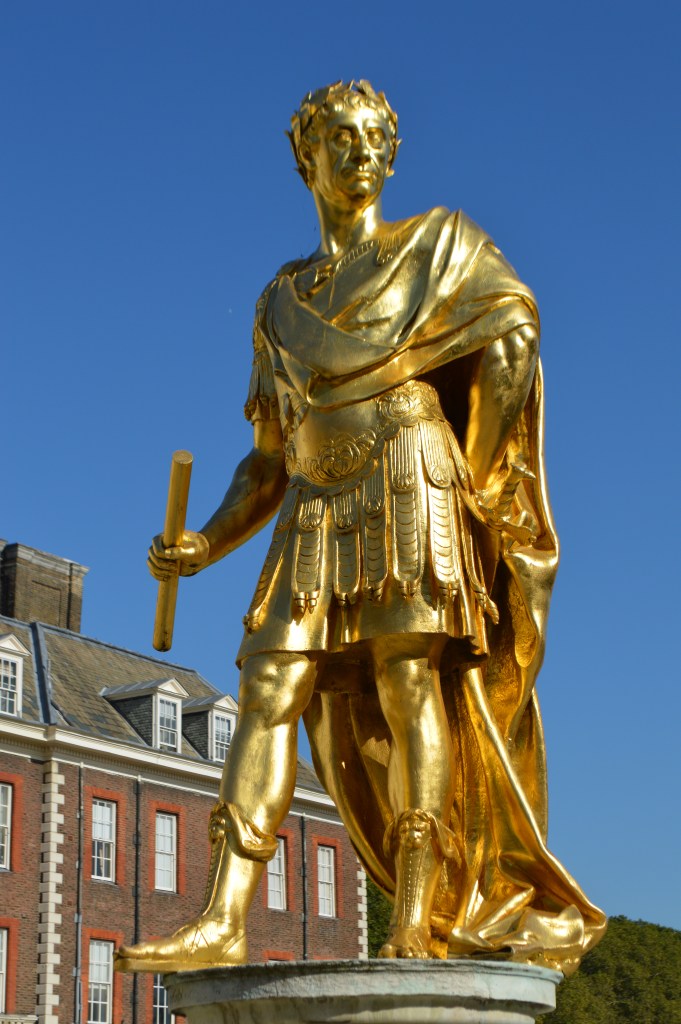
Despite the title, I do not really think we should cancel Caesar. We cannot meaningfully judge him by modern standards for actions taken 2000 years ago which were, if not entirely the norm, then not far beyond the expected standards of behaviour for a military commander. I do, however, think that it is odd that when we consider him today the human misery he inflicted is so easily set aside. Much like Alexander the Great, whose slaughter of the inhabitants of Tyre is generally disregarded, we remember the glitter, but forget the blood. This may seem trivial, given that both perpetrators and victims would be long dead either way, yet if we look around us we can see the impact which these ancient civilisations still have on our modern world. In every major western city it is possible to see monumental architecture consciously imitating the Classical world – how many of those empires sent out commanders to be their Caesar, their Alexander, their Trajan? In Britain we are still only beginning to fully unpick how colonial power has shaped our modern society, as well as coming to terms with some of the atrocities committed in our name. As we process our own imperial history, perhaps it is time to delve down to the roots of our conception of empire, and acknowledge the full and complete legacy of the ancient generals whose actions shaped both the Iron Age and the 21st century.

Further Reading:
Gilliver, Kate, Caesar’s Gallic Wars 58-50 BC (Oxford: Taylor and Francis group, 2004)
Goldsworthy, Adrian, Julius Caesar the final verdict, YouTube, 29th October 2025, https://www.youtube.com/watch?v=k_fsMfajfC0 [accessed 30 Oct 2025]
Raaflaub, Kurt. ‘Caesar and Genocide: Confronting the Dark Side of Caesar’s Gallic Wars’, New England Classical Journal vol.48, Issue 1 (2021) pp54-80 (available online at https://crossworks.holycross.edu/cgi/viewcontent.cgi?article=1350&context=necj)
Roymans, Nico. ‘A Roman massacre in the far north. Caesar’s annihilation of the Tencteri and Usipetes in the Dutch river area’, in Conflict archaeology. Materialities of collective violence in late prehistoric and early historic Europe, ed. by M. Fernández-Götz/N. Roymans (2018) ch.15, pp167-181 (available online at https://www.academia.edu/106272810/Roymans_A_Roman_massacre_in_the_far_north)
 Classic Examples